For twenty years, “search strategy” meant one thing: rank on Google. Build backlinks, target keywords, optimize page speed, climb the results page. That playbook isn’t dead—but it’s no longer the whole game.
Search has quietly split into three distinct layers, and most businesses are still playing only one of them. If your team’s entire visibility strategy still begins and ends with “where do we rank on Google,” you’re likely invisible in two channels that are growing faster than traditional search itself.
Let’s break down what’s actually changed, and what to do about it.
The Three Layers of Modern Search
1. SEO — Search Engine Optimization
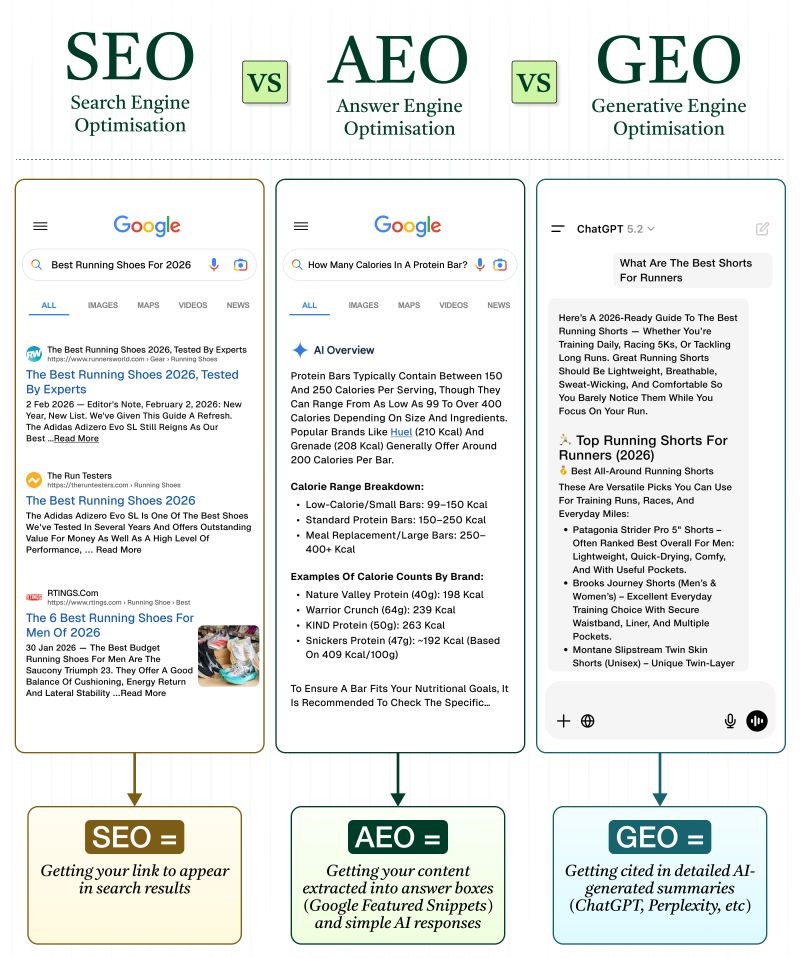
This is the layer everyone knows. SEO is about earning visibility in traditional search engine results pages (SERPs) — Google, Bing, and the like — so that people click through to your website.
The mechanics are well understood at this point: relevant keywords, quality backlinks, technical performance, site structure, and content depth. SEO is still the foundation of digital visibility, and it isn’t going anywhere. But it was built for a world where “search” meant typing a query into a box and scrolling through ten blue links. That world is shrinking.
2. AEO — Answer Engine Optimization
Increasingly, people don’t want links — they want answers. Featured snippets, “People Also Ask” boxes, voice assistants, and AI Overviews at the top of Google itself are all part of this shift. AEO is the discipline of structuring your content so it gets pulled directly into those answer formats.
This changes what “winning” looks like. A page can rank on page one and still lose the click, because the searcher got their answer from a snippet without ever visiting the site. AEO isn’t about being found — it’s about being extracted. That means clear, direct answers near the top of a page, structured data, FAQ formatting, and content written the way a person would actually ask a question out loud.
3. GEO — Generative Engine Optimization
The newest and least understood layer. When someone asks ChatGPT, Perplexity, Gemini, or Claude a question, the model generates an answer — and sometimes cites sources within it. GEO is about earning those citations: getting your brand, your data, or your expertise referenced inside AI-generated responses.
This is a fundamentally different game from SEO. Large language models aren’t crawling and ranking pages the way search engines do — they’re synthesizing information from training data and, increasingly, live retrieval. Being cited by an AI model doesn’t require ranking #1. It requires being clear, well-structured, and genuinely authoritative on a topic, in a way a model can confidently pull from and attribute.
Why the Distinction Actually Matters
It’s tempting to treat SEO, AEO, and GEO as three flavors of the same thing — “just optimize your content and you’re covered.” That thinking misses something important: each layer has different success criteria, and doing well in one doesn’t guarantee success in another.
A few things we see consistently:
- Ranking doesn’t guarantee AI citation. A page can sit at position one on Google and never get mentioned by ChatGPT, because the model weighs clarity, structure, and extractability differently than a search algorithm does.
- AI citation doesn’t guarantee traffic. Getting mentioned in an AI-generated answer is a brand-visibility win, but it often doesn’t send a click the way a SERP ranking does. The value is different — awareness and trust, not necessarily direct traffic.
- Search behavior has already fragmented. Some of your audience still opens Google. A fast-growing share opens ChatGPT or Perplexity instead and never touches a traditional search engine for that query. Optimizing for only one of these groups means you’re actively invisible to the other.
This is also, frankly, a resourcing problem. SEO has two decades of attribution tooling, dashboards, and reporting built around it — so it’s easy to keep investing where the numbers are visible. AEO and GEO have far less mature measurement infrastructure, which means budget and attention naturally drift toward the channel with a dashboard, even when the other channels are quietly driving real influence over buying decisions.
What This Looks Like in Practice
For a business trying to actually act on this, the shift isn’t about abandoning SEO — it’s about layering the other two on top of it.
For SEO: keep doing what works — technical health, keyword targeting, backlinks, content depth. This remains your foundation.
For AEO: restructure key content so the answer to the core question is stated clearly and early, not buried in paragraph four. Use FAQ sections, clear headers phrased as questions, and structured data (schema markup) that helps engines understand and extract your content.
For GEO: focus on being a clear, well-organized, citation-worthy source on the topics you want to own. That means original data, clearly stated facts, well-defined expertise, and content that’s easy for a model to summarize accurately — because AI systems tend to favor sources they can confidently attribute a claim to.
The Bottom Line
SEO, AEO, and GEO aren’t competing strategies — they’re three different surfaces where your audience is now looking for information, each with its own rules for visibility. Businesses that treat them as interchangeable, or that only invest in the one with the longest track record, are ceding ground in the channels growing fastest.
The question worth asking isn’t “how do we rank higher.” It’s: across all three layers — search results, answer boxes, and AI-generated responses — where does our brand actually show up?
That question is exactly where we focus at SEO AEO Masters. We help brands audit their visibility across all three layers, not just the one with the dashboard, so you’re not just found — you’re found everywhere your audience is actually looking.
Want to see where your brand currently stands across SEO, AEO, and GEO? Get in touch with SEO AEO Masters for a full visibility audit.